Youtube Analysis Available Here: https://youtu.be/C3lUDoG_J9Y
The middle section to “Paper Aeroplane,” is my tribute to three of my jazz guitar heroes, Joe Pass, Lenny Breau and Ted Greene, whose work in creating other worldly chord melodies with all sorts of inversions and techniques, inspired much of my guitar study towards the end of university. It is a moody chord progression, with a jovial floating melody over the top, and utilises a variety of interesting chord qualities. Here is the progression:
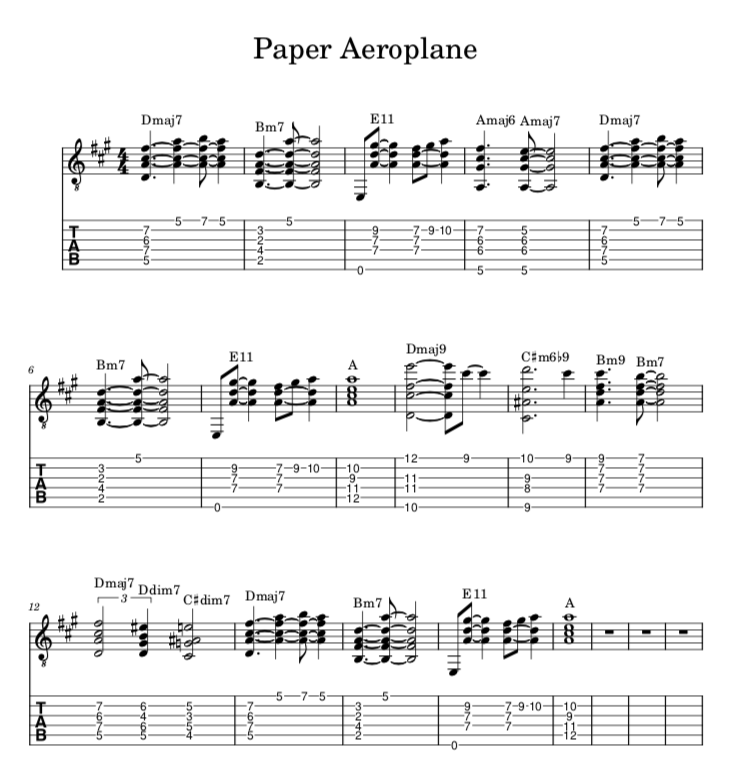
This is primarily a take on a traditional Doo-Wop I-vi-IV-V, constructed from D Lydian, so in A major, we are looking more at an IV-ii-V-I, the end of the sequence derived from a traditional Jazz progression.
The use of Dim7 chords is a reference to Joe Pass’ arrangement of ‘Ain’t Misbehavin’’ in which he uses long strings of diminished 7th and dominant chords to scale the entire neck, alternating each chord type as he goes. This is a very effective method for creating interesting chromaticism and implying chromatic jazz lines fully harmonised from single notes to chords. In a re-recording of this middle section, I used two guitars, one playing chords, and the other playing the melody, just to demonstrate how each chord complements the melodic notes.
The A at the end, is our Dominant leading back into Dmaj6, the first chord of the chorus and intro/re-intro progression. Here are the chords:
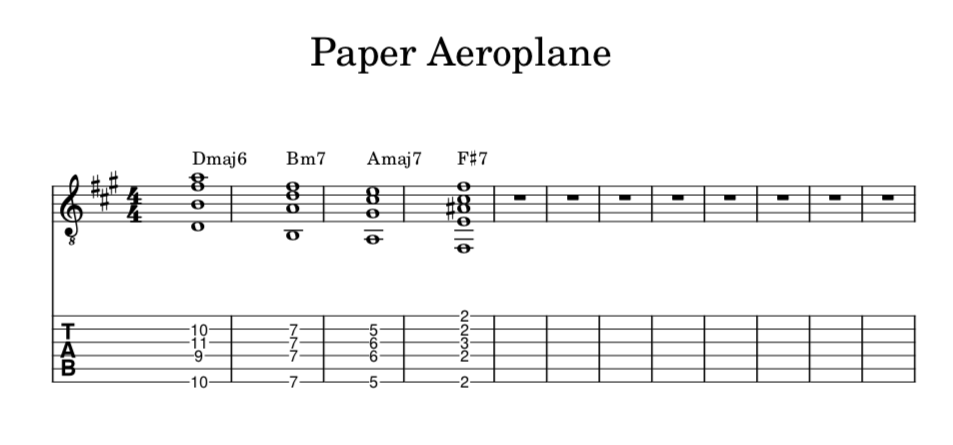
Dmaj6 and Bmin7 are synonyms of one another, as both chords contain, B, D, F# and A, but the difference in inversion, carries a different melodic content, with the bassline being played underneath in a Bossa Nova guitar style.
The speed of the chord changes is similar to Bossa Nova, and I am inspired by the likes of Sergio Mendes, Antonio (Tom) Jobim and Joao Gilberto. As a Jazz style, Bossa Nova is key to sit-in culture at Jazz band nights, with the opportunity for musicians to call a standard as a Bossa.
Bossa Nova carries an often relaxing and warm timbre of South America, perfect for a vocal, guitar or sax to smoothly improvise over, whilst appreciating the deceptively difficult chord changes. If I were to recreate this chart purely as an instrumental, there would be great opportunities for a soloist to play around with these changes in all parts of the song and play some very interesting melodies.
Whilst most modern music does not call for a guitar solo, my style of writing has lots of space for small, improvised parts during the song wherever there is space. So to call this song a kind of love letter to Bossa Nova and to the Jazz guitarists that made me obsess with the genre would be quite apt.
Youtube Analysis Here: https://youtu.be/C3lUDoG_J9Y

 Tom C- Blog and Collected Works