Thematically, this track deals with the anxiety of finding the next place to belong once everything behind you is starting to disappear. I used lots of open chords to experiment with less definite major and minor sounds, the suspense reflecting the subject matter. The tag line from the chorus is over the most common pop chord progression, the IV-V-I, which carries many styles, including blues and country.
This song is somewhere stylistically in the vein of Nick Drake or, more specifically Tom Waits. The guitar-only arrangement leaves opportunity for Piano, Brass and other instruments as heard on the albums ‘Closing Time,’ and ‘The Heart of Saturday Night.’ Waits as a Jazz-Folk character in the pop canon, harks back to themes that would have been popular in American cities during the 30s and 40s, such as lounge bars, hard drinking during prohibition and recreational drug use. Perhaps the painting ‘Nighthawks’ by Edward Hopper cuts the visual element of the song writing. This is almost my tribute to the tragic, yet sardonic and self-deprecating martyr figure Waits cuts in the music industry, by dealing with the theme of despair, knowing that it’s all your own fault, but doing nothing about it anyway.
Theoretically speaking, the bridge leads in with an Augmented D chord, to an F# minor. The use of F# minor and major next to one another in the progression allows the vocal line to cut in with the 3rds from both these chords and create engaging melodies.
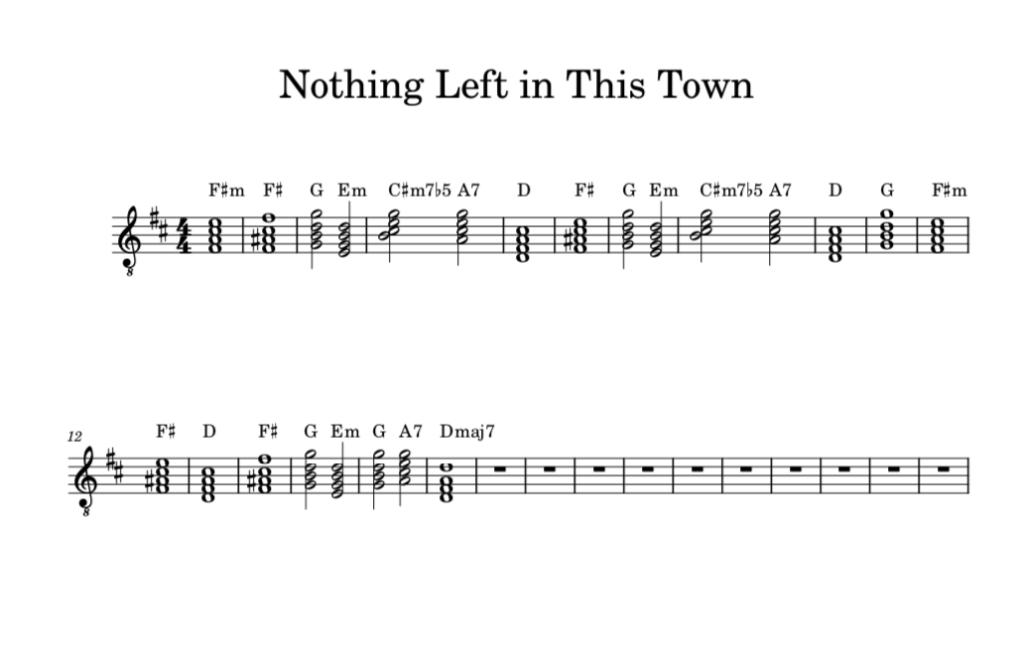
On the lines “what I’d do without it,” and “colouring the morning,” we hear C#m7b5- A7, leading into Dmaj7. This is a variation on a ii-V-I with our first chord being an inversion of E minor 13th to our Dominant A7. Chord substitutions are common in singer-songwriter music to fit with vocal melodies or to just to add interest to the sound of the song. Many songwriting theorists hark back to “50 Ways to Leave Your Lover,” by Paul Simon as a prime example of a great chord progression with lots of substitutions to nicely voice lead the song. For example, the F#m6 to B7+ in the song’s second phrase is an excellent substitution on a ii-V-I in E minor, the minor 6 bringing a flavour of melodic minor to an otherwise minor sounding chord progression. These small techniques have built up in my own work, creating options for where substitutions can be made meaningfully to bring the audience out of their comfort zone when listening to simple chords.
The use of inversions allows the songwriter to continue creating movement in their work, which best complements the song. Placing chord subs or the sake of chord subs can often feel unnatural which is why it is better to place them where it will add something to the feel or the sound of the song. What atmosphere do we want to create with our writing? If we can answer that question, we are better able to look within our arsenal of chords to handpick the ones that are most suitable.

 Tom C- Blog and Collected Works