Youtube video link- https://youtu.be/JoxTjNR4kT0
The obsession in my work with summer, and what it offers in inspiration for my writing, is best embodied within this song. There is great simplicity in being able to go outside on a bright, hot day and enjoy the natural feel of sitting on the beach with a beer in hand, listening to the sound of the waves. The upbeat swing tempo to this song perhaps would call for an orchestra if arranged properly, much in the style of Bobby Darin, Louis Armstrong, or Count Basie. The main progression of Gm7, Am7 and Bbmaj7 is a nod to the main progression of “Summertime,” one of the great Jazz standards, which constructs a beautiful picture of a warm summer evening with it’s cool, jazzy, Dorian tonality and free flowing vocal improvisations of Armstrong and Fitzgerald.
There is modal interchange functioning between G Dorian and G Lydian, which anchors back into D major, the parent key, towards the end of the chorus. Here are the chords to the chorus:
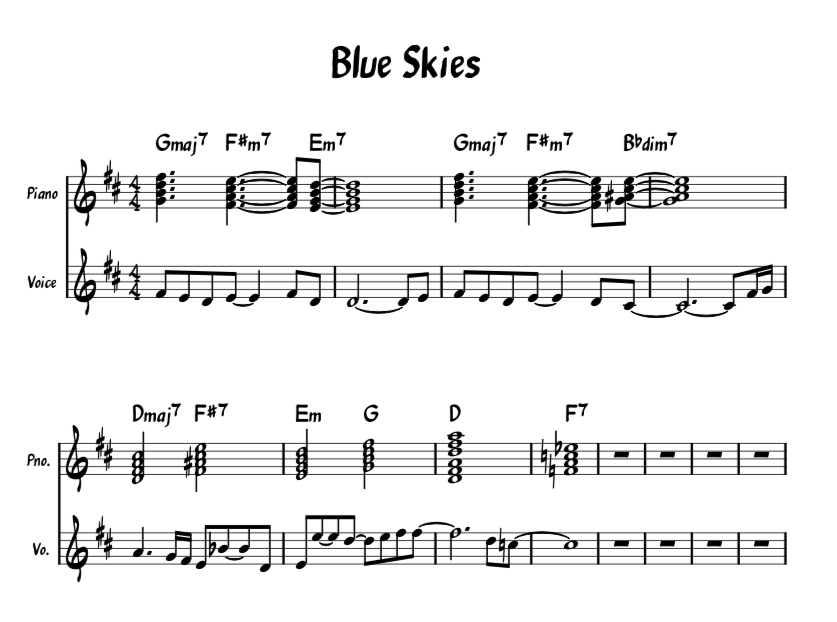
The chorus is constructed mainly from D major, with alterations on the sixth chord in the sequence, implying harmonic minor, and the secondary dominant F#7 built from the third of D major. By moving the chords in bars 5 and 6 upwards in pairs of parallel diatonic 4ths, we create a swell leading up to a triumphant D major chord on the lyric, “in love,” in bar 7. The root major has associations with success. The F7 at the end, acts as the V of Bb, the relative minor of which is G, the first chord in our verse progression. This circularity allows for a smooth transition between verse and chorus, without the need to deviate too greatly when returning to our original key.
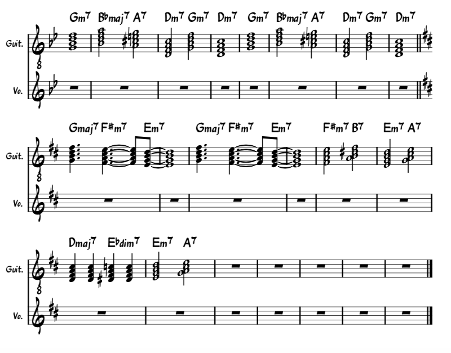
In the middle section, I have attempted to make a chord progression which utilises both the major and minor facets of the song together but links them using other common jazz practices such as ii-V-I progressions a whole tone apart. This creates the descending feel which is common in jazz songs with moving basslines.
This is also a common technique used in Ted Greene’s guitar arrangements to move from one key to the next, and functions well on guitar as the chords can all be found in similar boxes to one another. This allows me to voice lead a melody, similar to that in ‘Paper Aeroplane,’ for the purpose of adding interest to the chords with other tones. The chord progression has a similar form to a jazz standard, with an A and a B section, differentiated by the key signature marking, between G minor and D major.
Watch the analysis on Youtube: https://youtu.be/JoxTjNR4kT0

 Tom C- Blog and Collected Works