Youtube Analysis Available Here: https://youtu.be/fzCpvBObJ8s
The song came to partially after waking up from a dream, the day before I had spent time by the sea in the early hours of a summer morning under the influence of a mild psychedelic drug. I wanted to create something which captured the susurration and the movement of the ocean in its patterns of tension and release. Therefore, the song deviates between patches of simple chords and darker, more complex progressions which utilise melodic and harmonic minor.
The key example of these interesting techniques come In the song’s main sequence, which appears 4 times. Here are the chords:
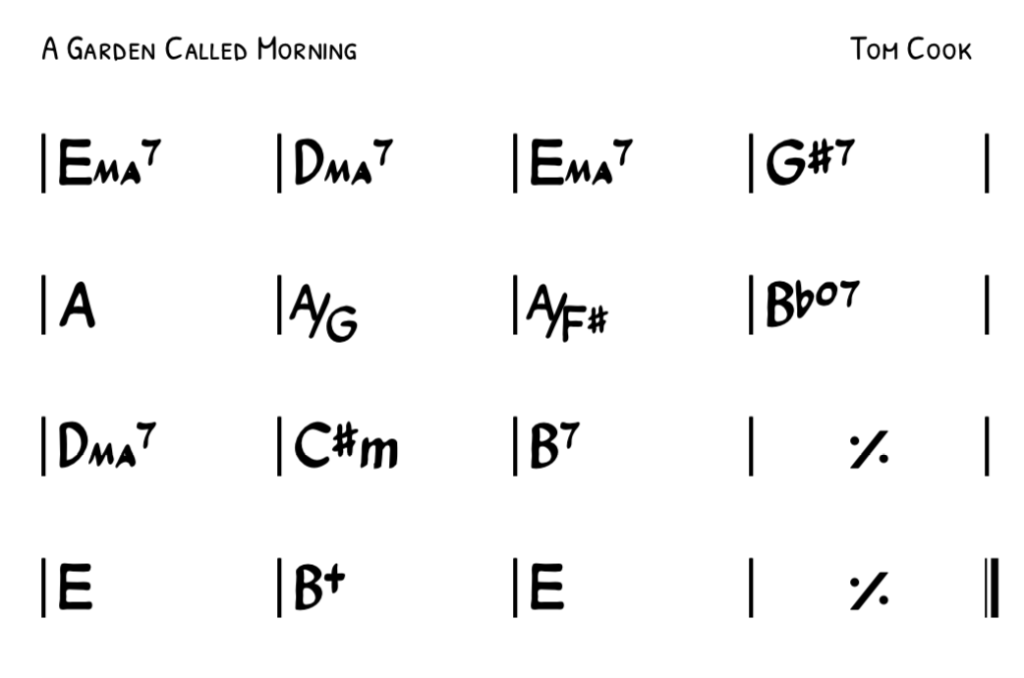
Beginning with a D Lydian sound, the first three bars use Emaj7 and Dmaj7, and allow the 4th chord (G#7) to provide the first piece of tension. This chord voice leads nicely up a semitone to A major.
Instead of using A major as the I, to return to Ionian from Lydian, the progression then devolves into Mixolydian with a descending bassline in the chord progression. It was easier to label each chord with its’ bass note underneath than the chord’s quality, to provide a guitarist with a simpler concept of how the chords lead into one another.
A, A/G, A/F# and the final Bbdim7 taken from the leading tone of B harmonic minor, create a sense of tumbling downwards, or being pulled away. Another way of looking at the Bdim7 is that It functions as a sub for A7(b9) which would lead back to Dmaj7, the next chord in the progression.
We then move from D maj7 to C#min7, which we would expect implies we’re back in A major, but that is confounded by the secondary dominant B7 to lead back into E major.
The modal interchanges and the use of secondary dominants allows this progression to move rapidly between keys, colours and sounds.
The C section of the track adopts a chordal trope common to RnB, and some other songwriters, such as Stevie Wonder. This trope is a movement from a major chord to a dominant chord a semitone below. It appears in such tracks as “Just the Two of Us,” and “Overjoyed.” The chord progression for this small passage within the C section is as follows:
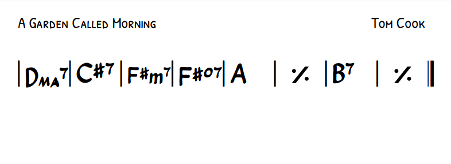
This is a tritone substitution of G7 as both chords contain the same 3rds and 7ths. The root notes between Dmaj7 and C#7 however, voice lead beautifully into one another.
G7- G B D F
C#7- C# F G# B
This is a functional and interesting way of voice leading well with chords, as it demonstrates that a guitarist, at the right level of study, can find quicker ways to jump to play similar more interesting chords, by learning the tritone subs to each dominant chord.
“A Garden Called Morning,” is filled with interesting imagery, mostly associated with drug use and its’ effect on the body and mind. “I’ve lost control of my legs, they take me where they feel,” is an expression of the often-lucid sense of freedom the body gains under the influence of drugs and alcohol, this is paired with the contrast of feeling trapped during a negative experience, “you feel your thoughts are dragging you in, whilst you’re sat there in your chair.” This again, is accentuated in the chord choices and how in the B section there is a progression, A7 to Bbdim7 which implies a sense of danger and mystery. This is an indicator of how word painting has become a concurrent theme in my work.
Youtube Analysis Available Here: https://youtu.be/fzCpvBObJ8s

 Tom C- Blog and Collected Works